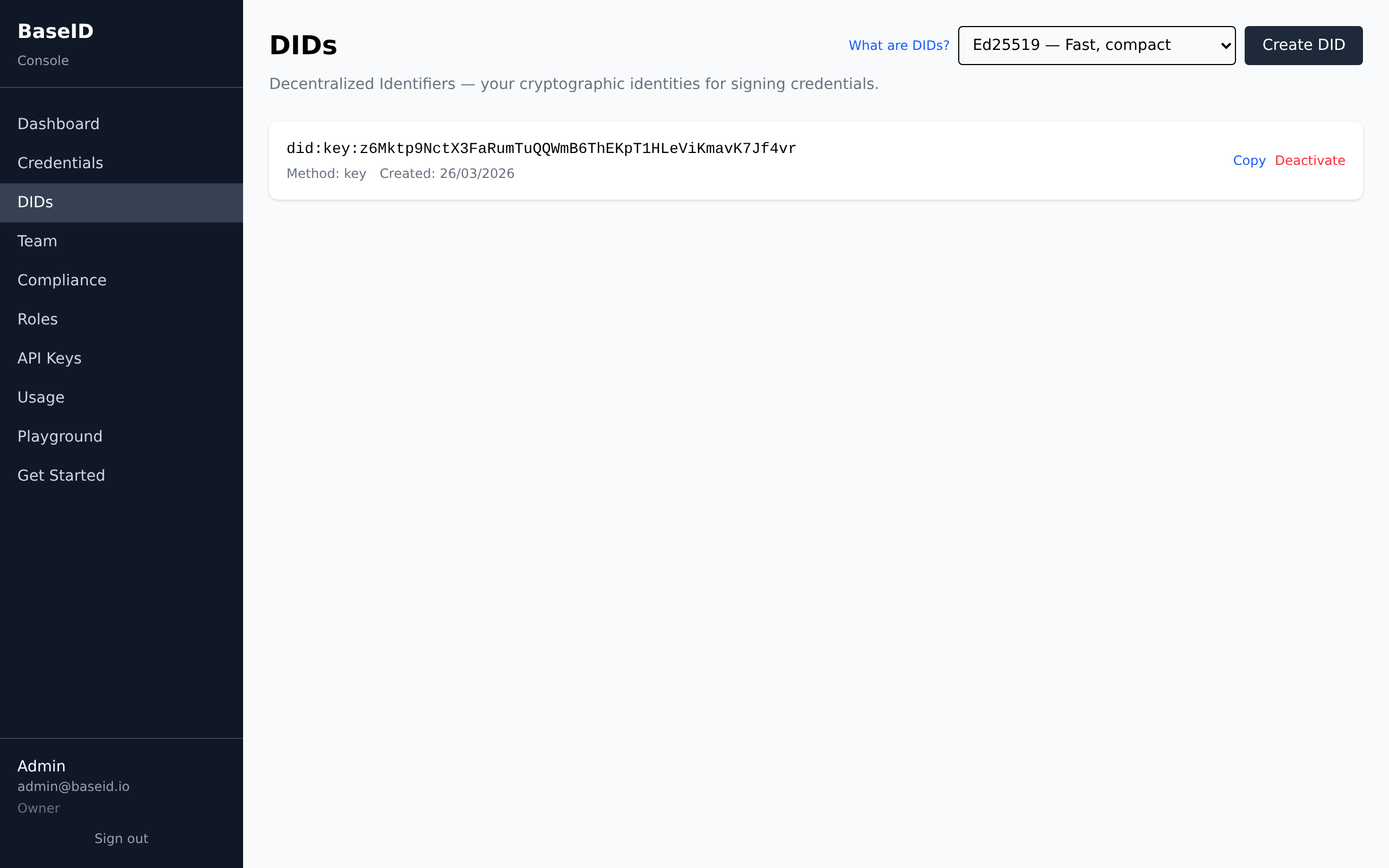
Console: DIDs
What is a DID?
Section titled “What is a DID?”A Decentralized Identifier (DID) is a globally unique identifier that you control, backed by a cryptographic key pair. In BaseID, DIDs serve as your issuer identity — they sign credentials you issue.
A DID looks like: did:key:z6MkhaXgBZDvotDkL5257faiztiGiC2QtKLGpbnnEGta2doK
Creating a DID
Section titled “Creating a DID”Select a key type and click Create DID. The key pair is generated server-side and the private key is stored encrypted in your tenant’s database.
Key types
Section titled “Key types”| Key type | Algorithm | Best for |
|---|---|---|
| Ed25519 | EdDSA | General purpose. Fast signatures, compact keys. Recommended default. |
| P-256 | ES256 | WebAuthn/FIDO2 compatibility. Required by some enterprise systems. NIST-approved. |
| P-384 | ES384 | Higher security margin. Required by some government standards (e.g., HAIP profile). |
Which key type should I choose?
Section titled “Which key type should I choose?”- Start with Ed25519 unless you have specific requirements
- Use P-256 if integrating with WebAuthn, Apple/Google attestation, or FIDO2
- Use P-384 if targeting HAIP compliance or government procurement requiring ES384
DID methods
Section titled “DID methods”BaseID currently supports did:key — the public key is encoded directly in the DID identifier. No external resolution infrastructure needed.
Deactivating a DID
Section titled “Deactivating a DID”Deactivation is permanent and means:
- The DID can no longer issue new credentials
- Credentials already issued remain valid and verifiable
- The key material is preserved but marked inactive
Deactivate a DID when you want to rotate to a new key or retire an identity.
Plan limits
Section titled “Plan limits”Each plan has a maximum number of DIDs. Check your current usage on the Usage page. Upgrade your plan to create more DIDs.
See the DIDs API reference for programmatic usage.
See also
Section titled “See also”- DIDs concept — methods, resolution, key lifecycle
- DIDs API — programmatic DID management
- Security Model — key storage architecture